
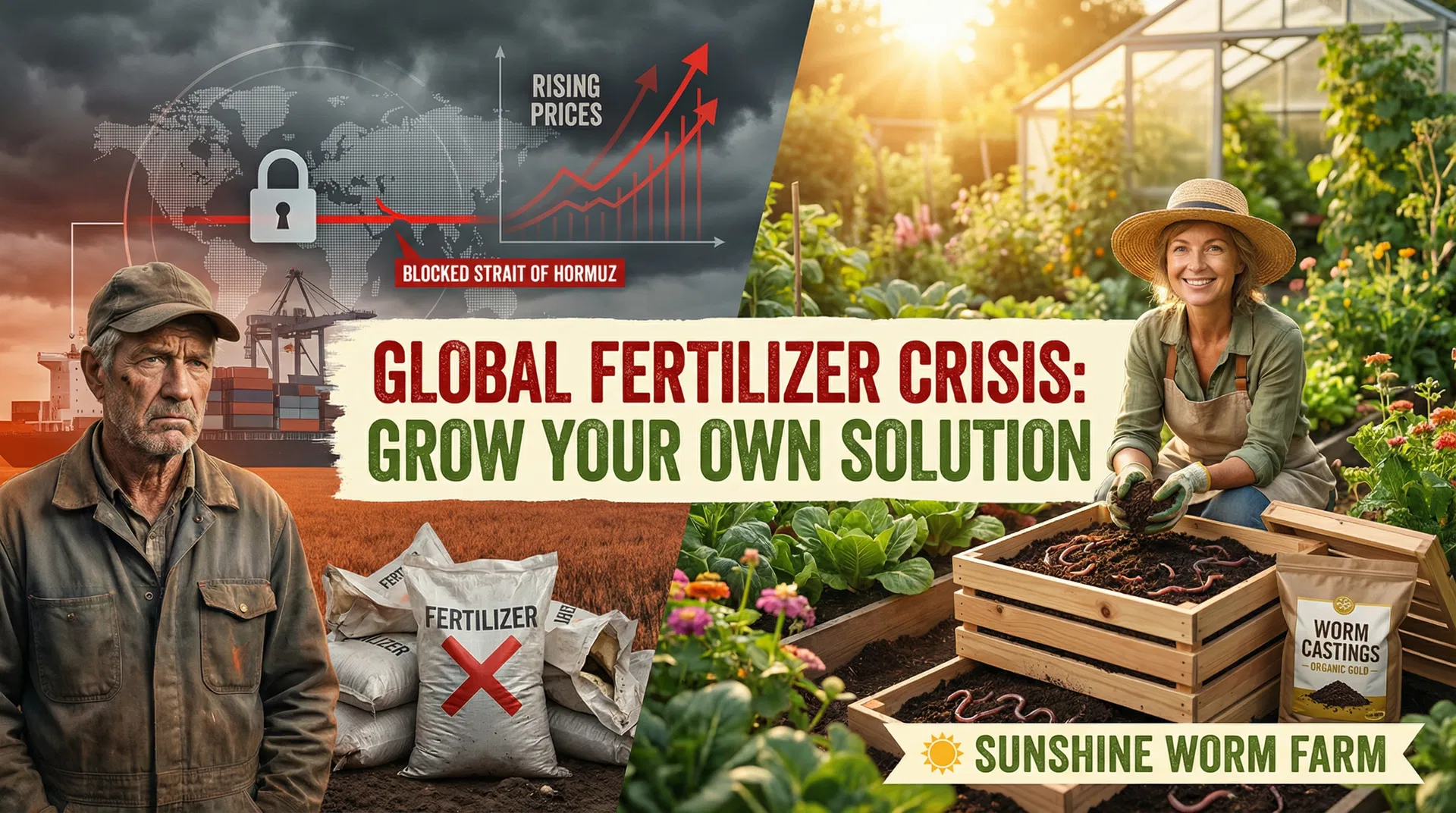
Global Fertilizer Crisis: Why Your Garden Needs Worm Castings Now More Than Ever
Global Fertilizer Crisis: Why Your Garden Needs Worm Castings Now More Than Ever
The Perfect Storm: Middle East Conflict Threatens Food Security Worldwide
The world's food supply is facing an unprecedented crisis. As geopolitical tensions escalate in the Middle East, the Strait of Hormuz—a critical 33-kilometer-wide waterway that handles the vast majority of global fertilizer shipments—has become a chokepoint that threatens gardeners and farmers worldwide. The implications are staggering: between 3 and 4 million tonnes of fertilizer per month cannot reach markets due to shipping disruptions and production halts at major facilities.
For home gardeners, this means one thing: traditional synthetic fertilizers are becoming increasingly expensive and unreliable. But there's a solution that's been growing right under our noses—literally. Worm castings and worm tea brewing kits offer gardeners a way to achieve food independence and escape the volatility of global supply chains.
Understanding the Crisis: Why the Middle East Matters
Most people don't realize how dependent the world is on a single region for fertilizer production. The Persian Gulf produces the majority of the world's synthetic nitrogen fertilizers, particularly urea—the most commonly used nitrogen fertilizer globally. This concentration exists for one simple reason: cheap, abundant natural gas.
The Haber-Bosch process, which has been used for over a century to synthesize ammonia and create nitrogen fertilizers, is extraordinarily energy-intensive. It requires massive amounts of natural gas to convert atmospheric nitrogen into a form that plants can use. The Middle East, blessed with abundant fossil fuel reserves, became the world's fertilizer factory.
The Numbers Tell the Story
The current crisis is severe and immediate. Between 3 and 4 million tonnes of fertilizer per month cannot reach markets. India buys more than 40% of its urea from the Middle East, while Australia depends on the region for 50%+ of its urea. Prices have spiked dramatically—urea arriving via New Orleans jumped 17% immediately after the conflict began, with contract prices increasing by 35% in just two weeks.
Qatar, one of the world's largest urea producers, was forced to halt production at one of its major facilities during the current planting season—the worst possible timing. As of 2022, Qatar's fertilizer exports alone were keeping nearly 43 million people fed across the United States, Brazil, and India.
The situation is being described as worse than Russia's invasion of Ukraine, which triggered the last major fertilizer supply shock.
The Hidden Cost: More Than Just Price
When fertilizer prices spike, the impact cascades through the entire food system. Higher fertilizer costs mean higher food prices at the grocery store. For gardeners, it means paying significantly more for the same nutrients. But there's another hidden cost: dependence on a system you cannot control.
As long as gardeners rely on synthetic fertilizers shipped across fragile global supply chains, they remain vulnerable to geopolitical events thousands of miles away. A conflict in the Middle East, a shipping blockade, or a natural disaster can instantly make fertilizer scarce and expensive.
This is where worm castings change the equation entirely.
The Solution: Worm Castings—Local, Sustainable, Reliable
Worm castings are nature's perfect fertilizer, and they can be produced anywhere. Unlike synthetic fertilizers that depend on natural gas, global shipping, and geopolitical stability, worm castings require only three things: worms, organic matter, and time.
Why Worm Castings Outperform Synthetic Fertilizers
Superior Nutrient Density: Worm castings are not just fertilizer—they're a complete soil amendment. They contain 7 times more phosphates, 5 times more nitrogen, and 11 times more potash than average topsoil. But the real magic isn't just in the numbers; it's in the living microorganisms that come with them.
Living Fertilizer: Synthetic fertilizers are dead chemistry. They provide immediate nutrients but do nothing to improve your soil's long-term health. Worm castings, by contrast, are teeming with beneficial bacteria, fungi, and microorganisms that establish themselves in your soil and continue improving it for months and years.
No Burn Risk: One of the biggest problems with synthetic fertilizers is that they can burn plants if applied incorrectly. Worm castings are so gentle that you literally cannot over-apply them. More is always better, never worse.
Immune System for Plants: The beneficial microorganisms in worm castings don't just feed plants—they protect them. Beneficial bacteria colonize leaf surfaces, preventing disease and improving overall plant health.
Supply Chain Independence: This is the critical difference. You can produce worm castings in your backyard, your basement, or your garage. You don't need to wait for a ship to arrive from the Middle East. You don't need to hope that geopolitical tensions don't spike fertilizer prices. You're in complete control.
Worm Tea Brewing Kits: Amplify Your Results
If worm castings are the foundation, worm tea is the turbocharger. A worm compost tea brewing kit allows you to create a liquid fertilizer from your worm castings—a nutrient-rich solution that delivers immediate results.
How It Works: Steep worm castings in water with aeration to extract all the beneficial nutrients and microorganisms into a liquid form. The result is a potent, living fertilizer that plants absorb immediately through both leaves and roots.
Immediate Results: While worm castings work gradually in the soil, worm tea provides an instant nutrient boost. Foliar feeding (spraying on leaves) delivers nutrients directly where plants can use them immediately. You'll see visible results within days—stronger growth, deeper green color, and increased vigor.
Perfect for Crisis Times: When fertilizer supplies are tight and prices are high, worm tea brewing kits let you stretch your resources. A small amount of worm castings can produce multiple batches of tea, multiplying your fertilizer production.
The Sunshine Worm Farm Advantage
At Sunshine Worm Farm, we've been helping Florida gardeners achieve fertilizer independence for years. Our premium worm castings are produced right here in Brooksville, Florida, using sustainable vermicomposting methods. We don't ship from the Middle East. We don't depend on natural gas or the Haber-Bosch process. We depend on the simple, elegant power of worms.
Our worm compost tea brewing kits come complete with everything you need:
- 1-Gallon Kit ($45): Perfect for container gardeners and small raised beds
- 3.5-Gallon Kit ($65): Ideal for medium gardens and multiple applications
- 5-Gallon Kit ($85): For serious gardeners who want to brew in volume
Each kit includes a premium aerator and instructions for creating nutrient-rich tea that will transform your garden.
What Gardeners Are Saying
The feedback from gardeners who've switched to worm castings and brewing kits is overwhelming. They report stronger plants, higher yields, and most importantly, peace of mind. They're no longer at the mercy of global supply chains. They're growing food security in their own backyards.
The Bottom Line: Build Your Own Fertilizer Independence
The Middle East conflict is a wake-up call. It reveals the fragility of a food system that depends on a single region, a single energy source, and a single shipping route. But it also presents an opportunity.
By switching to worm castings and brewing your own worm tea, you're not just growing better plants. You're building resilience. You're creating a local, sustainable, independent fertilizer system that no geopolitical crisis can disrupt.
The best time to build food security is before you need it. Don't wait for fertilizer prices to spike further or for supplies to become truly scarce. Start your worm composting system today. Invest in a brewing kit. Join the growing movement of gardeners who are taking control of their own food production.
Your garden—and your wallet—will thank you.
Found this helpful? Share it with fellow gardeners!